5 Signs Your Dog Is Overheating — Texas Summer Guide
Table of Contents
Hi. It's Bella.
And I need to tell you something important.
Because last July in Texas…
I almost didn't make it back inside in time.
My human thought I was just tired.
I wasn't tired.
I was overheating.
And the scary part?
She almost missed it.
⚠ Texas Dog Owners — Read This First
Texas summers regularly hit 100–110°F. Pavement temperature can exceed 150°F. Dogs overheat in under 15 minutes in direct sun. French Bulldogs, Pugs, and other flat-faced breeds are at highest risk — their anatomy makes it physically harder to cool down by panting. If your dog shows any of the signs below, act immediately.
Why Dogs Overheat Faster Than You Think
Humans cool down by sweating across the entire body.
Dogs can't do that.
They cool almost entirely through panting — pushing hot air out and pulling cooler air in. When the outside air temperature is already 100°F, that system starts failing. There's no cool air to bring in. Panting becomes less effective, body temperature rises faster, and what looks like "just tired" becomes a veterinary emergency in minutes.
Flat-faced breeds like French Bulldogs, English Bulldogs, Pugs, and Boston Terriers are at especially high risk. Their shortened airways mean they can't pant efficiently even in mild conditions. In Texas summer heat, that's a serious vulnerability.
The ASPCA and veterinary sources consistently list heatstroke as one of the most common summer emergencies for dogs. Texas, Florida, and Arizona account for a disproportionate share of heat-related dog incidents nationally — because the heat here is relentless, not seasonal.
The 5 Signs Your Dog Is Overheating
Sign 1 — Excessive, Unrelenting Panting
Every dog pants after exercise. That's normal.
What's not normal is panting that doesn't stop — even after rest, even in the shade, even after coming indoors. If your dog is panting harder than usual for their activity level, and the panting doesn't slow down within a few minutes of rest in a cool space, something is wrong.
In brachycephalic breeds, watch especially carefully. Because their baseline panting is already noisier and more labored than other breeds, the escalation to dangerous panting can be subtle. If Bella is panting harder than normal for her — not just normal levels — that's the signal.
"My panting is already impressive in normal conditions. When it gets excessive even by my standards — that's when my human knows something is wrong. Know your dog's baseline. It matters."
— Bella 🐾
Sign 2 — Drooling More Than Usual
Some dogs drool normally. But sudden, heavy drooling — especially thick or ropey saliva — is a warning sign of heat stress. The body is working overtime trying to cool itself, and the mouth is part of that system.
If your dog isn't normally a drooler and you suddenly see strings of thick saliva, especially combined with panting, get them to a cool space immediately. This is one of the earliest visible signs that the body is under heat stress — before more serious symptoms appear.
Sign 3 — Bright Red or Pale Gums
This one most owners don't check — and it's one of the most reliable indicators.
Healthy dog gums are pink and moist. When a dog is overheating, gums can turn bright red (early overheating, blood rushing to the surface to cool down) or pale/grey (late-stage, circulatory stress). Either is an emergency.
Make a habit of checking your dog's gum color on walks in summer. Take 3 seconds. Lift the lip, look at the gum color, press with your finger and watch the color return. This takes no time and can tell you more than any other quick check.
💡 Quick Gum Color Guide
Pink and moist — normal ✓
Bright red — early heat stress, cool down now ⚠
Pale, grey, or white — emergency, call vet immediately 🚨
Sign 4 — Lethargy, Stumbling, or Disorientation
A dog that suddenly slows down dramatically, wants to lie down in the middle of a walk, seems confused, or has trouble walking straight is showing signs of heat exhaustion progressing toward heatstroke.
This is not "just tired." A dog that was fine ten minutes ago and is now stumbling or disoriented has had a rapid body temperature increase that is affecting their neurological function. This is a veterinary emergency.
In Texas summer, this can happen on a walk as short as 15–20 minutes if the temperature and humidity are high enough and your dog is a heat-sensitive breed.
Sign 5 — Vomiting or Diarrhea During or After a Walk
Gastrointestinal distress is a sign the body's heat management systems are failing. When core temperature rises too high, blood is diverted away from the digestive system toward vital organs, causing nausea and GI upset.
A dog that vomits after a summer walk, especially combined with any of the signs above, has likely experienced significant heat stress. Cool them down, offer small amounts of room-temperature water, and contact your vet.
🚨 If Your Dog Is Overheating Right Now
1. Move to shade or air conditioning immediately
2. Apply cool (not ice cold) water to paw pads, armpits, and neck
3. Offer small amounts of room-temperature water — not ice water
4. Place on a cool surface — tile floor, or a cooling mat
5. Call your vet or emergency animal hospital if symptoms don't improve in 10 minutes — ASPCA Emergency: (888) 426-4435
What Texas Dog Owners Get Wrong About Summer Safety
The biggest mistake isn't the walk itself. It's the timing.
In Texas from June through September, pavement temperature at noon can exceed 150°F — hot enough to cause paw burns in under 60 seconds. The ground your dog walks on is actively radiating heat upward, which means your dog is being heated from below as well as above.
Walk before 8 AM or after 8 PM. If you must walk mid-day, keep it under 10 minutes and stay in shade. Grass is significantly cooler than pavement — route your walks through parks and lawns, not sidewalks.
And when you're home — don't assume air conditioning is enough. Dogs on tile floors or outdoor patios in partial sun can still overheat even with AC running nearby. What your dog rests on matters.
"I am a French Bulldog in Texas. The odds are not in my favor in July. My human learned this the hard way. Now she walks me at 7am and I have a cooling mat by the back door. Non-negotiable."
— Bella 🐾
The One Thing That Changed Everything for Bella
My human tried everything.
Earlier walks. More water breaks. Shorter routes.
All of it helped.
But what made the biggest difference for recovery after any outdoor time?
Having something cool to come back to.
Not ice. Not a wet towel that goes room temperature in 20 minutes.
A proper self-cooling mat that works the moment I lie down on it — no electricity, no water, no prep. Just instant relief.
The ice silk surface pulls heat away from my body on contact. That's physics, not marketing. The material has a lower thermal resistance than fabric, which means heat transfers from my warm body into the cooler mat surface faster than it would into air or regular fabric.
The result for me: I come in from a walk, lie down on it, and my panting slows down in 2–3 minutes instead of 10–15. That's not a small difference in Texas in August.
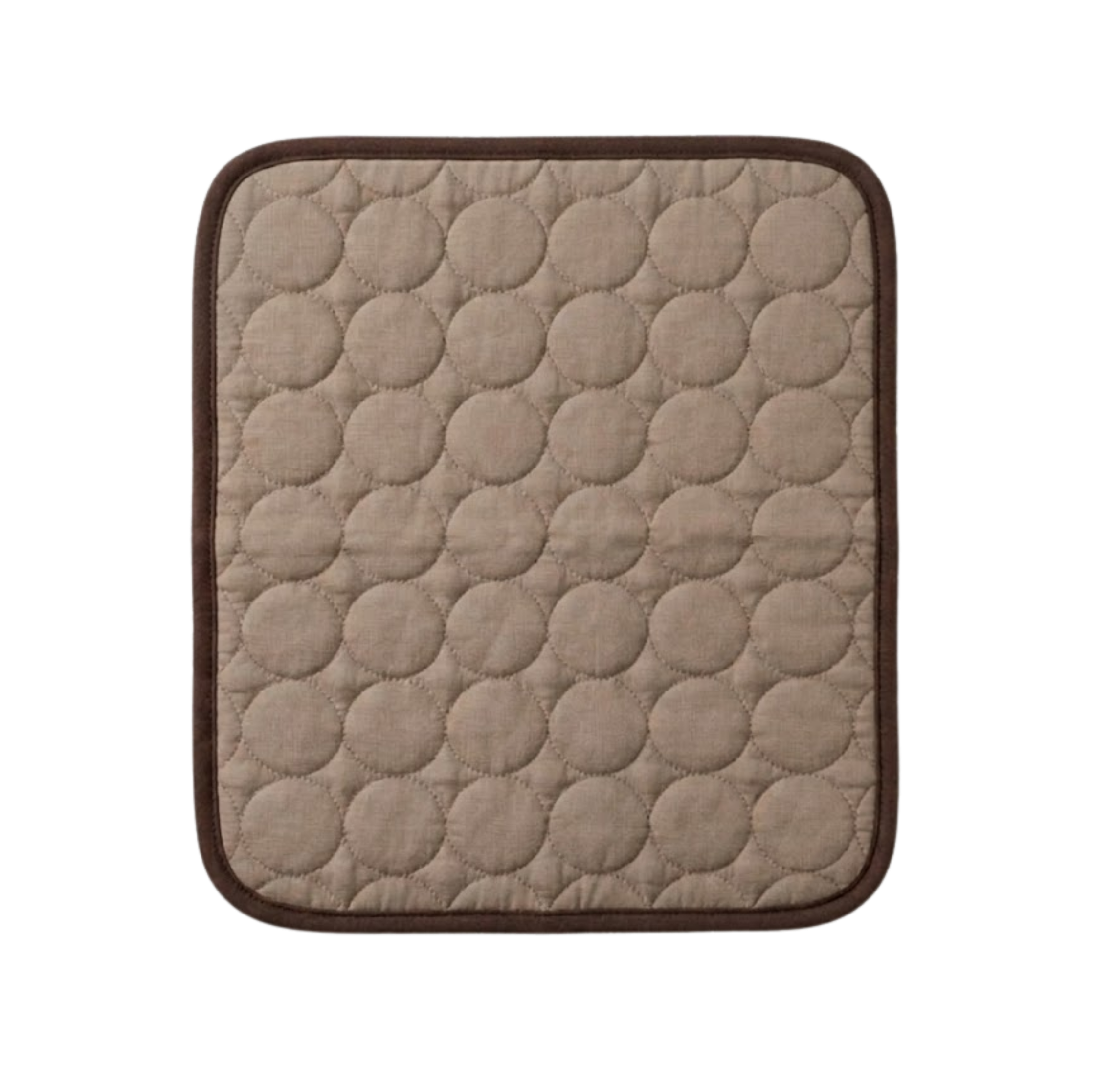
🐾 Bella Approved — Texas Essential
Self-Cooling Dog Mat for Heat Relief
$29.99
Ice silk surface pulls heat away on contact. No water, no electricity, no prep. Bella's first stop after every Texas summer walk. Fits dogs of all sizes.
Texas Summer Dog Safety — The Full Checklist
Beyond recognizing the signs, here's what responsible Texas dog owners do every summer:
- Walk before 8 AM or after 8 PM — pavement stays hot long after sunset but is significantly safer than midday
- Test the pavement with your hand — if you can't hold it for 7 seconds, it's too hot for your dog's paws
- Always carry water — a portable squeeze bottle is non-negotiable on any summer walk
- Know your dog's baseline — panting, energy level, gum color in normal conditions, so you recognize the difference
- Have a cooling surface ready indoors — the transition from hot outside to cool inside needs something to land on
- Never leave your dog in a parked car — car temperature in Texas summer can reach 160°F in under 10 minutes
- Know your breed's risk level — flat-faced breeds need shorter outdoor time and more vigilant monitoring than other breeds
- Have your vet's number saved — and the ASPCA emergency line: (888) 426-4435
"I survived every Texas summer because my human paid attention. She knew the signs, she adjusted the schedule, and she made sure I had somewhere cool to come back to. That's the whole job."
— Bella 🐾
The Bottom Line
Texas summers are beautiful and brutal in equal measure.
Your dog can't tell you they're overheating until they're already in trouble.
That's why you need to know the signs before you need them — excessive panting that won't stop, heavy drooling, red or pale gums, sudden lethargy or disorientation, and GI distress after outdoor time.
Know them. Watch for them. Act fast when you see them.
And give your dog somewhere cool to come home to.
Bella tested the cooling mat personally. It's the first thing she looks for when she comes inside.
🐾 Built for Texas summers
Give your dog somewhere cool to come home to
No electricity. No water. No prep. Just instant cooling on contact — tested by Bella, a French Bulldog who takes Texas heat very seriously.
Shop the Cooling Mat →Free shipping · Ships across the USA